

How 12 Brands Found $1M+ They Didn’t Know They Had
What is POS consolidation in trade marketing?
POS consolidation is the process of coordinating fragmented point-of-sale orders across brands, regions, or teams to unlock bulk pricing, reduce duplicate freight, and eliminate wasteful spend that’s invisible inside siloed programs.
Nobody planned to waste it. That’s the part that makes this story worth telling.
A top-five global wine and spirits company had 12 brands running POS programs across the country. Separate teams, separate budgets, separate vendor relationships. Each brand was ordering neon signs — the kind you see lit up behind a bar, on a back shelf, in a retail display. And each of them was doing it alone.
The vendor was the same. The product was the same. But because no one could see across the portfolio, none of the 12 brands knew the other 11 were placing nearly identical orders.
That’s not a budgeting problem. That’s a visibility problem. And visibility problems don’t show up on a P&L until someone builds a system that can show you what’s actually happening.
What did the data show when POS spend was consolidated?
When brandhub connected the spend data across all 12 brands, the pattern was immediate. All 12 were ordering the same product from a pool of four vendors, completely uncoordinated. No consolidated purchase event, no volume pricing, no shared freight.
The simplest way to describe what was happening: the same company was paying retail rates for a wholesale problem.
The savings were always there. They were just invisible.
The data was always there.
brandhub was the first system that actually showed us what we were doing to ourselves. We left hundreds of thousands of dollars on the table every year — and it was completely invisible.-VP of a top-5 Wine & Spirits company
How does POS order consolidation work across multiple brands?
Once the overlap was surfaced, the path forward was straightforward. brandhub consolidated all 12 brand orders into a single purchase event. One vendor. One shipment. One logistics event covering all 12 brands.
The result wasn’t a complicated procurement overhaul. It was simply making something visible that had been hidden, and then acting on it.
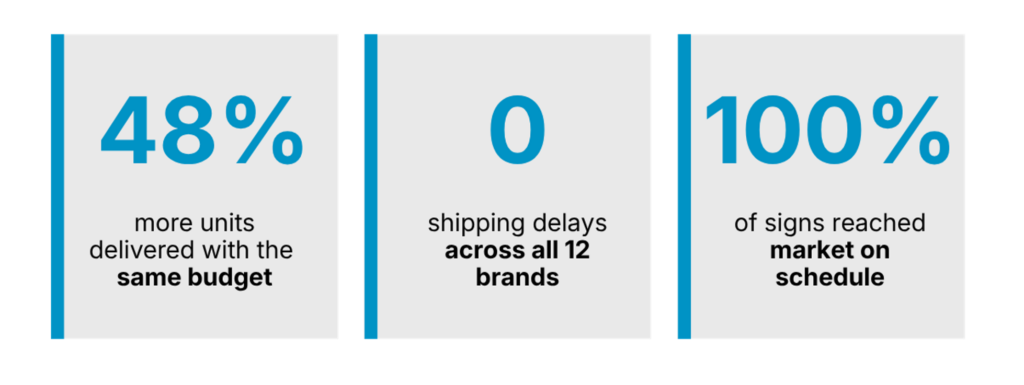
That last number matters. Zero delays, full on-time delivery across a 12-brand program. Not only did the consolidation cost less, it actually executed better.
Why does POS waste persist in alc bev trade marketing?
Trade marketing in alc bev runs through distributors, through regional teams, through brand managers who each own a slice of the portfolio. The three-tier system is built for relationships, not data aggregation. You can have excellent people making smart decisions in their individual lanes and still leave significant money on the table because nobody has a view across the lanes.
That’s not a failure of judgment. It’s a failure of infrastructure. Spreadsheets, email threads, and brand-by-brand vendor relationships weren’t designed to surface cross-portfolio patterns. They were designed to manage individual transactions.
The question isn’t whether your team is doing their job. It’s whether your tools can show you what your team can’t see from where they sit.
What does $1M+ in hidden trade marketing savings actually represent?
The consolidation win alone delivered significant unit savings. When you account for the freight eliminated across 12 separate shipments, and the productivity recovered when teams stopped managing four vendor relationships for the same product, the full value picture grows considerably.
More importantly, this was recurring spend. The same orders, the same vendors, the same fragmented pattern happening year after year. A visibility problem at this scale doesn’t cost you once. It costs you every cycle.
How do you find POS consolidation opportunities in your own portfolio?
Most brands we talk to aren’t dealing with obvious waste. They’re running tight programs, managing budgets carefully, doing the work. But they’re doing it without full visibility into what’s happening across their own portfolio.
If your trade marketing spend is managed by multiple teams, across multiple brands, ordering from overlapping vendor sets, the question isn’t whether there’s consolidation opportunity. The question is whether you have the system to find it.
The data is almost certainly already there.
SHARE:
IN OUR CUSTOMER’S WORDS
READY TO SEE WHAT’S POSSIBLE?
READY TO SEE WHAT’S POSSIBLE?
Start with the platform, start with the production, or let’s just talk
through what you’re working on.